




Product description
Maturity and Quality
Color (yellow, orange, and/or red) on 75% of fruit surface and soluble solids/acid ratio of 6.5 or higher.
- Color intensity and uniformity
- Size
- Shape
- Firmness
- Freedom from decay
- Freedom from defects including freezing injury, chilling injury, insect damage, and scars
- Flavor depends upon soluble solids/acid ratio and absence of off-flavors
Postharvest Handling and Storage
5-8°C (41-46°F) for 2 to 6 weeks, depending on cultivar, maturity-ripeness stage at harvest, and decay control treatments used.
90-95%
| Temperature | 5°C (41°F) | 10°C (50°F) | 15°C (59°F) | 20°C (68°F) |
| ml CO2/kg·hr | 2-4 | 3-5 | 6-10 | 10-15 |
To calculate heat production multiply ml CO2/kg·hr by 440 to get Btu/ton/day or by 122 to get kcal/metric ton/day.
- Mandarins and tangerines can be degreened by exposure to 1-10 ppm ethylene for 1-3 days at 20 to 25°C (68 to 77°F)
- Removal of ethylene from transport vehicles and storage facilities for citrus fruits can help reduce decay incidence
A combination of 5-10% O2 and 0-5% CO2 can delay color changes from green to yellow and other symptoms of senescence, but it is not very effective in decay control. Mandarins do not tolerate exposure to fungistatic CO2 levels (10-15%). Commercial use of CA is very limited.
Temperature & Controlled Atmosphere Photos
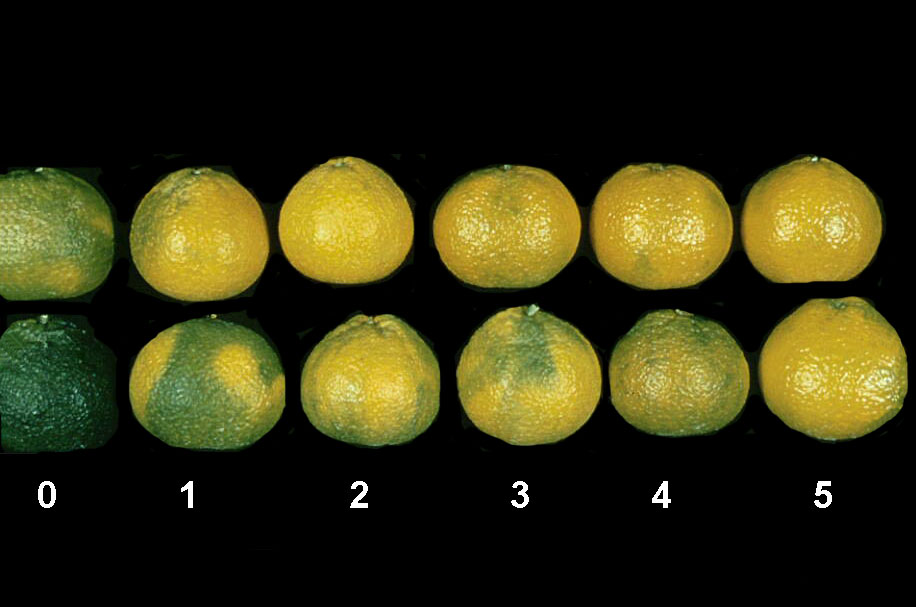
Title: Degreening. Photo Credit: Irv Eaks, University of California, Riverside
Physiological and Physical Disorders
Chilling injury. Symptoms include pitting and brown discoloration followed by increased susceptibility to decay. Severity increases with longer exposures to lower temperature below 5°C (41°F).
Oil spotting (Oleocellosis). Harvesting and handling turgid citrus fruits can result in breaking of oil cells and release of oil that damages surrounding tissues.
Aging. Symptoms include shriveling and peel injury around the stem end.
Pathological Disorders
Major Diseases:
- Green mold (Penicillium digitatum)
- Blue mold (Penicillium italicum)
- Phomopsis stem-end rot (Phomopsis citri)
- Stem end rot (Lasiodiplodia theobromae)
- Brown rot (Phytophthora citrophthora)
- Anthracnose (Colletotrichum gloeosporioides)
Control Strategies
Reduce the pathogen population in the environment:
- Effective preharvest disease control
- Use of chlorine in wash water
- Heat treatments
- Effective sanitation procedures
Maintain Fruit Resistance to Infection
- Minimize mechanical injuries
- Use proper ranges of temperatures and relative humidity throughout postharvest handling
- Use postharvest fungicides and/or biological antagonists
- Avoid exposure to ethylene
References
References from scientifically validated sources will be added in the future.