





Product description
Maturity and Quality
Dragon fruit are generally harvested close to full ripe stage because they do not continue ripening after harvest. As the fruit matures and ripens, skin color changes to red or yellow, total soluble solids (TSS) increases to a peak, and titratable acidity (TA) as well as flesh firmness start decreasing. The commonly-used maturity indices are days after flowering (minimum of 27 to 33 days, depending on cultivar and production area) and intensity of red or yellow skin color.
- Fruit size
- Skin color (red, purple, or yellow)
- Absence of defects, including insect damage, skin splitting, mechanical damage, chilling injury, water loss, and decay.
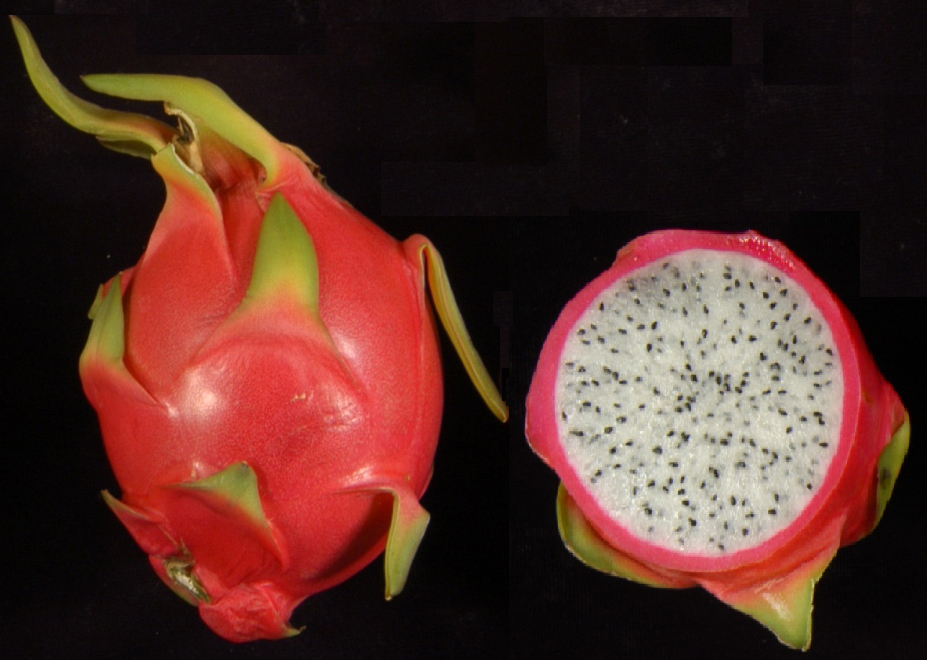
- The flesh can be white (Hylocereus undatus) or various hues of red (Hylocereus polyhizus), depending on the species and cultivar.
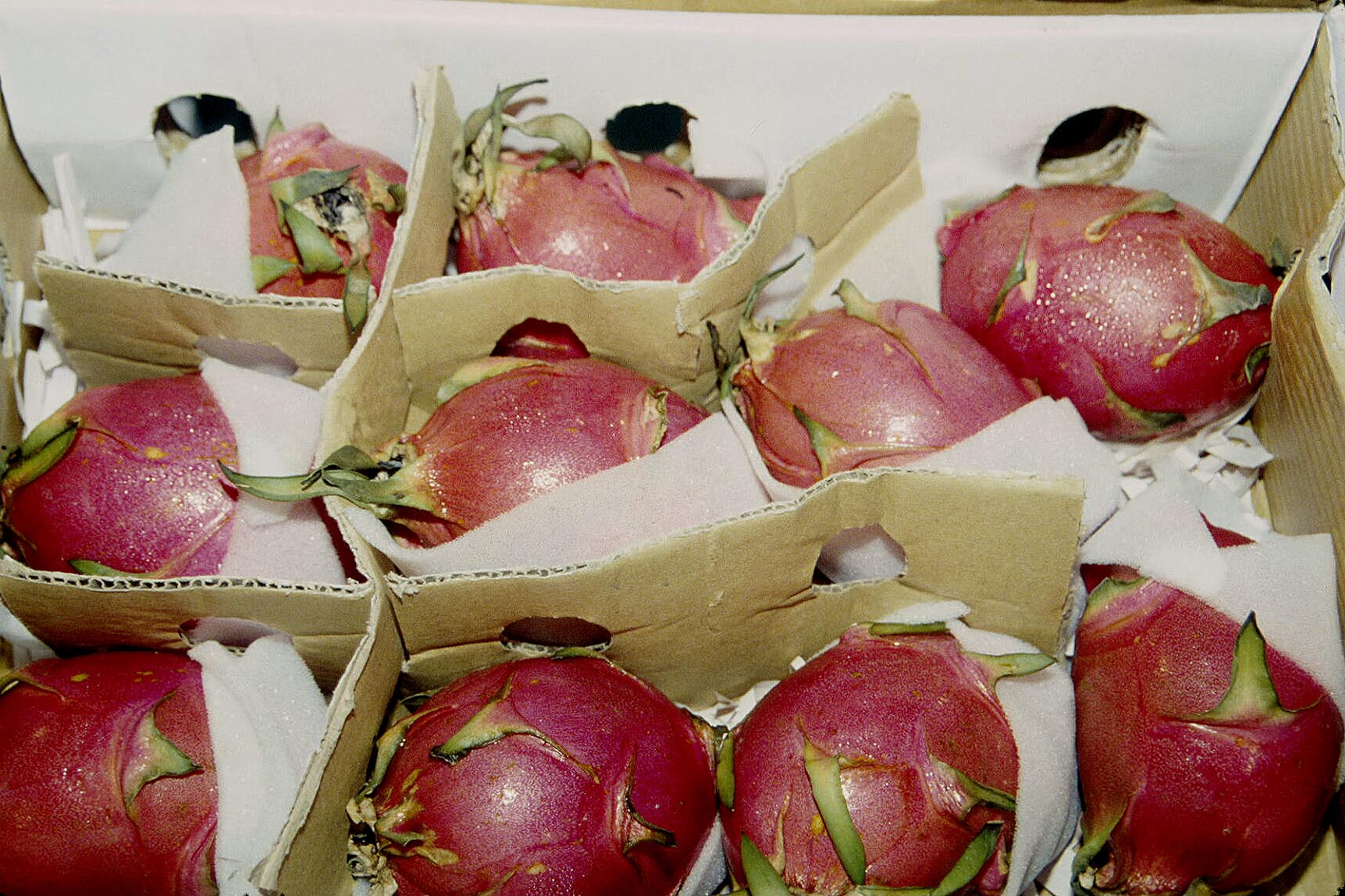
- Top quality fruit should be well shaped, have firm, fleshy and green bracts, firm flesh, and a minimum TSS:TA ratio of 40.
Postharvest Handling and Storage
Red pitaya (Hylocereus undatus and H. polyrhizus) and yellow clones of H. undatus: 10ºC (50ºF)
Yellow pitaya (Selenicereus megalanthus): 6ºC (43ºF)
85-90%
41-79 ml CO2/kg.h at 20-23ºC (68-73ºF)
0.01-0.09 µl C2H4/kg•h during fruit growth and development.
Ethylene production does not increase during fruit ripening. Based on the pattern of CO2 and C2H4 production, pitaya is a non-climacteric fruit.
Ripening changes in the fruit are independent of ethylene. Ethylene treatment has no effect on the initiation of fruit color development.
Modified atmosphere studies show that fruit harvested 30 days after flowering and stored in modified atmosphere bags with oxygen, transmission rate of 4 L m-2 day-1 for ~5 weeks at 10ºC (50ºF) had less dehydration and scale wilting, and better maintenance of fruit color with greener scales compared to fruit stored without bags at the same temperature. It is unknown how much benefit is due to a modified atmosphere as compared to the higher relative humidity within the bags. More mature fruit and storage at higher temperatures reduces the beneficial effects of modified atmospheres.
Temperature & Controlled Atmosphere Photos
Physiological and Physical Disorders
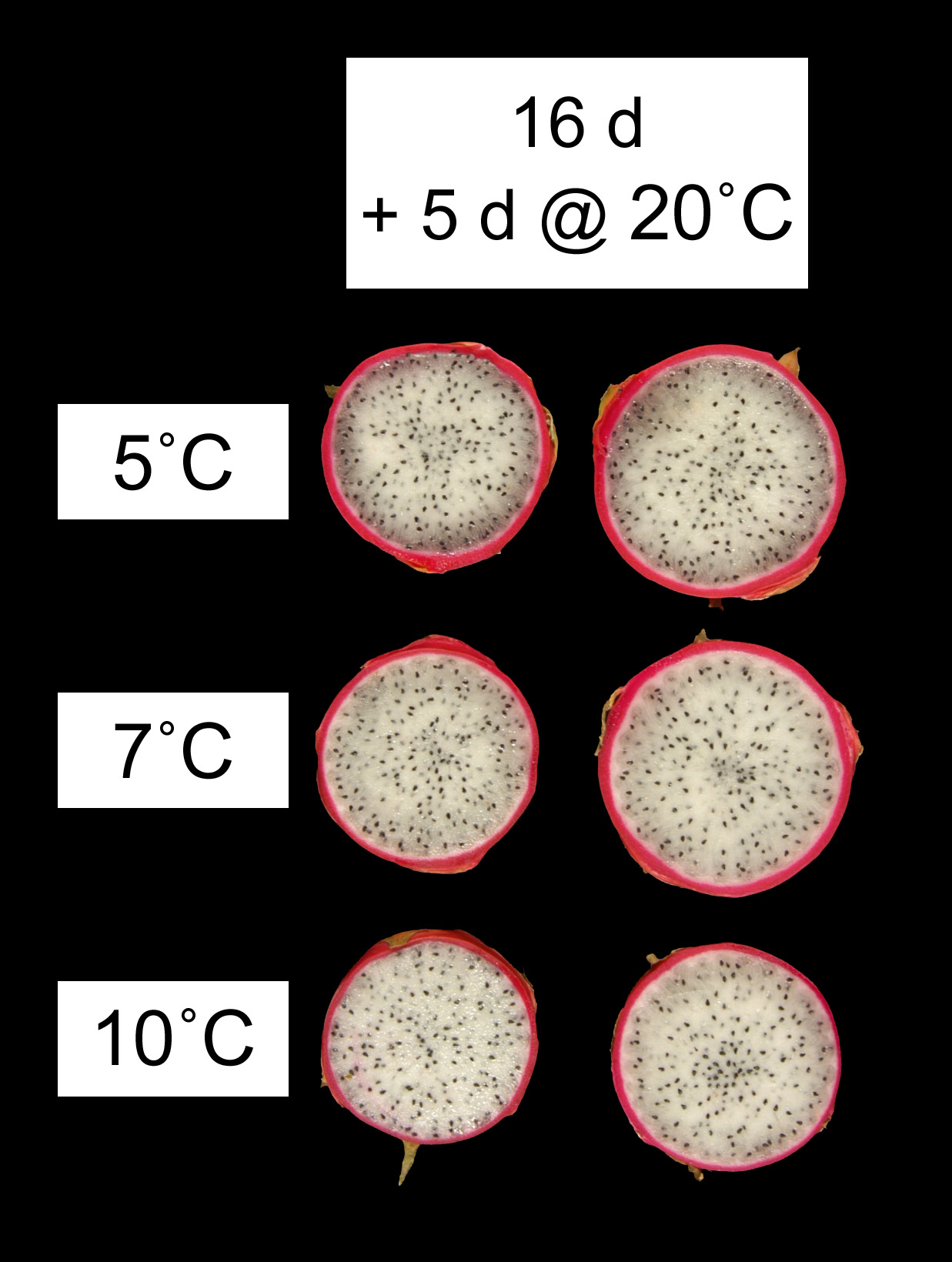
Chilling injury. Chilling injury can develop at 5 or 6°C (41 or 43ºF), depending on the genus, harvest maturity and growing location. Early harvest increases fruit sensitivity to chilling injury. Chilling injury is characterized by flesh translucency, softening, wilting, darkening of scales, browning of the outer flesh and poor flavor.
Mechanical injury. Injury due to abrasion of the skin makes the fruit unsightly and increases the rate of water loss resulting in shriveling. Fruit should be handled carefully and packaged in protective containers to reduce abrasion and compression injury.
Water loss. Pitaya fruit are very susceptible to water loss. The rate of fruit weight loss per day is about 0.1% at 5ºC (41ºF), 0.3% at 10ºC (50ºF), and 2.6% at 20ºC (68ºF) for H. undatus. However, holding fruit inside perforated plastic bags to maintain higher RH around the fruit can reduce fruit weight loss per day to as low as 0.05% at 5 and 10ºC (41 and 50ºF). Water loss results in loss of saleable weight and unsightly shriveling.
Pathological Disorders
Susceptibility to pathogens is greater in stem end tissues, scales, and tissue showing physical damage.
Anthracnose. Caused by Colletotrichum gloeosporioides and appears as reddish-brown lesions on fruit which develop from chlorotic halos.
Other decays:
- Stem rot caused by Xanthomonas campestris
- Brown spots on fruit caused by Dothiorella sp. and Monilinia fructicola.
- Other fungal pathogens that can cause decay on pitaya fruit are Fusarium spp. and Aspergillus spp.
Quarantine Treatment. Hot air treatment to a core temperature of 46.5 ºC (116ºF) and holding for 20 minutes can be used for fruit fly disinfestations caused by Bactrocera spp.
Control strategies
Include minimizing physical injuries during harvest and handling, and using good sanitation practices and good temperature management. As of 2011, no postharvest fungicides are approved by EU or US authorities for use on dragon fruit.
References
References from scientifically validated sources will be added in the future.