




Product description
Maturity and Quality
Snow Peas are selected for size and maximal recovery of bright green, flat pods with minimal seed enlargement. Older and yellowing pods are avoided by careful hand-harvesting.
Sugar Snap Peas are selected in a similar manner but some degree of seed-pod filling is desirable. Larger seeds rapidly become starchy.
Edible-pod peas should be uniformly bright green (light to deep green but not yellow-green), fully turgid, clean, and free from damage (Thrip injury, broken pods). The stem and calyxes should be green and there should be very few blossoms attached to the pods.
U.S. Grades: U.S. Fancy, and U.S. No. 1, (established in June 1942)
Standards for Fresh Peas apply to Snap Peas but not Oriental Peas
Postharvest Handling and Storage
0°C (32°F)
Edible-pod peas are highly perishable and will not maintain good quality for more than 2 weeks. Wilting, yellowing of pods, loss of tenderness, development of starchiness and decay are likely to increase following storage beyond 14 days; defects occur faster at common distribution conditions of 5 to 10°C (41 to 50°F).
95-98%
| Temperatura °C | ml CO2/kg·hr |
| 0 (32°F) | 15-24 |
| 5 (41°F) | 27-38 |
| 10 (50°F) | 34-59 |
| 15 (59°F) | 89-101 |
| 20 (69°F) | 123-180 |
To calculate heat production, multiply ml CO2/kg·hr by 440 to get BTU/ton/day or by 122 to get kcal/metric ton /day.
Respiration rates for edible-pod peas are an approximation based on values for unshelled garden peas; actual values remain to be determined.
Peas are moderately sensitive to exogenous ethylene. Accelerated yellowing and decay will result from extended exposure to low levels of ethylene during distribution and short-term storage. The calyx is more sensitive to ethylene than the pod.
Reports vary widely in the benefit of CA for Sugar and Snap Peas. Atmospheres of 2 to 3% O2 and 2 to 3% CO2 are considered by UC Research to offer the best, but moderate, benefit to peas beyond that of rapid cooling and proper storage. Low O2 may promote off-flavors and off-odors. Other studies report that 5 to 7% CO2 extends pod quality at 0°C.
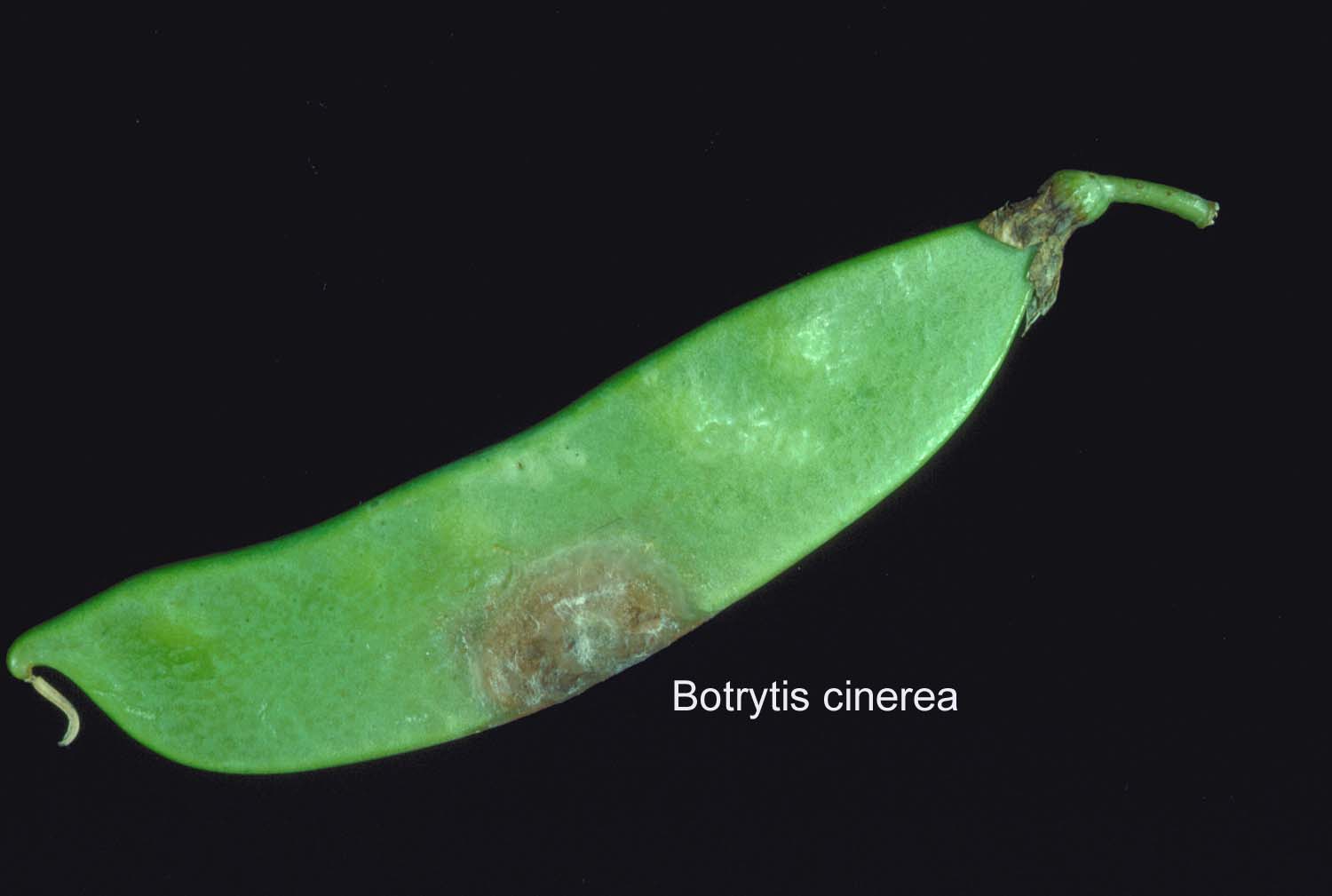
Package-icing and top-icing loads may be used for Snow Peas but is typically detrimental to Snap Peas because surface moisture promotes decay. Improper CA/MA conditions in ready-to-cook vegetable medleys often leads to off-flavors and fungal decay (typically Botrytis grey mold) at the blossom-end of the pod.
Physiological and Physical Disorders
Freezing. Freezing injury will be initiated at -0.6°C (30.9°F). Freezing injury results in watersoaking typically followed by rapid decay by soft-rot bacteria.
Premature senescence. (Yellowing of pod, browning of calyx, loss of tenderness) will develop rapidly at temperatures 7.5°C (45°F) due to the high rate of respiration.
Harvesting and handling should be done with care to prevent damage to the pods and attached calyx.

Pathological Disorders
A variety of fungal pod-spotting and decay pathogens affect edible-pod peas. Common diseases include Chocolate Spot and Grey mold (Botrytis cinerea), Watery Soft Rot (Sclerotinia sclerotiorum), Rhizopus Rot, and Ascochyta Pod Spot. Bacterial Soft Rot is common following rough handling or freezing injury. Surface decay can occur readily, on weak calyxes (brown at harvest) and on blossom remains.
References
References from scientifically validated sources will be added in the future.