




Product description
Celery (Apium graveolens) is a crisp, aromatic vegetable characterized by its long, fibrous stalks and leafy green tops. It has a mild, slightly savory flavor with a refreshing crunch and subtle bitterness. Commonly marketed in bunches or as trimmed stalks, celery is widely used for its versatility in both raw and cooked applications. It may be eaten fresh in salads and vegetable trays, or used as a foundational ingredient in soups, stews, and sautéed dishes. Celery is a good source of dietary fiber and contains vitamins such as vitamin K and vitamin C, contributing to its nutritional value.
Maturity and Quality
Celery is harvested when the field reaches the desired marketable size and before the outer petioles develop "pithiness" (see Pith Breakdown below). Celery has very uniform crop growth, and fields are harvested only once. The stalks are then packed by size after trimming the outer petioles and leaves. Any leaves remaining on the stalk after trimming should not be wilted, yellowed, or decayed.
High-quality celery consists of well-formed stalks with thick petioles, a compact appearance (not significantly bowed or bulging), minimal petiole twisting, and a light to bright green color with a fresh appearance (Fig. 1, Fig. 2). Additional quality indices include stalk and midrib length, freedom from defects such as blackheart, pithy petioles, seed stalks, cracks or splits, and freedom from insect damage and decay.
U.S. Grades: Extra No. 1; No. 1; No. 2 (Grade Standards established 1959)
Celery may be sold as "Unclassified" to designate a lot that has not been graded according to U.S. standards.

Fig. 1. Green color rating scale for celery petioles. The total chlorophyll concentrations for scores 1 to 5 were 3.2, 2.8, 2.4, 1.4, and 0.7 mg/100 g fresh weight. Photo credit: Marita Cantwell

Fig. 2. Color scores, color values, and chlorophyll content of celery leaves. Photo credit: Marita Cantwell
Postharvest Handling and Storage
0°C (32°F)
At optimum conditions, celery should retain good quality after storage for up to 5 to 7 weeks. Celery is commonly rapidly cooled and then stored at 0 to 2°C (32 to 36°F). If storage is intended to be less than one month, storing celery at 5°C (41°F) is not recommended for more than 2 weeks to maintain good visual and sensory quality (Fig. 3). Some continued growth of inner stalks will occur postharvest at temperatures above 0°C (32°F) during prolonged storage.

Fig. 3. Appearance of celery after storage for 24 days at 2.5°C (36°F) or 7.5°C (45°F). Photo credit: Marita Cantwell
98-100%
| Temperature | 0°C (32°F) | 5°C (41°F) | 10°C (50°F) | 15°C (59°F) | 20°C (68°F) |
| ml CO2/kg·hr | 5-8 | 6-13 | 11-22 | 14-28 | 26-52 |
To calculate heat production multiply ml CO2/kg·hr by 440 to get Btu/ton/day or by 122 to get kcal/metric ton/day.
Celery produces little ethylene, <0.1 μL kg-1 h-1 at 20 °C (68 °F).
Celery is not very sensitive to exogenous ethylene at low levels and low temperatures. Loss of green color (Fig. 4) can result from exposure to ethylene concentrations of 10 ppm or higher at temperatures above 5°C (41°F).

Fig. 4. Appearance of celery after storage for 1 week at 5°C (41°F) in air or in air containing 10 ppm ethylene. Photo credit: Adel Kader.
Controlled or modified atmospheres offer a small to moderate benefit to celery. Delayed senescence and decay development have been observed at 2-4% O2 and 3-5% CO2. Injury from low O2 (<2%) or elevated CO2 (≥10%) can induce off-odors, off-flavors, and internal leaf browning. CA for long-distance transport of celery has some commercial applications. Elevated CO2 levels delay leaf yellowing and decay but cannot be used in mixed loads with lettuce (lettuce does not tolerate CO2-enriched atmospheres).
Cutting the petioles of celery, as a fresh-cut product, makes them susceptible to bacterial decay. Using sharp blades reduces decay and slows the appearance of decay symptoms by minimizing abrasions or other damage to the cut ends during packaging, while also ensuring good sanitation and temperature control.
Physiological and Physical Disorders
Blackheart. Internal leaves develop a brown discoloration that eventually turns deep black. The cause is similar to tip burn in lettuce or blossom-end rot in tomatoes. Although many predisposing factors may be involved, water stress leads to a calcium deficiency disorder that ultimately causes cell death.
Brown Checking. Splits, primarily along the inner surface of the petioles, result from boron deficiency.
Freezing Injury. Freezing injury (Fig. 5) will be initiated at -0.5°C (31.1°F). Symptoms of freezing injury include a water-soaked appearance on thawing and wilted leaves. Mild freezing causes pitting or short streaks in the petiole, which develop a brown discoloration with additional storage.

Fig. 5. Freeze damage on celery (no damage on the upper petiole). Photo credit: Adel Kader
Pith Breakdown. The breakdown of the internal tissue of the petiole, the pith (Fig. 6), is often referred to as "pithiness" or pithy stems. The aerenchyma tissue of the petiole becomes white, spongy, or vacuolated, and appears dry. Pith breakdown is induced by several factors that trigger senescence, including cold or heat stress, water stress, pre-bolting changes (seed stalk induction), and root infections. Pithiness is also associated with over-maturity. Pith breakdown develops after harvest, but it occurs slowly under proper storage conditions.
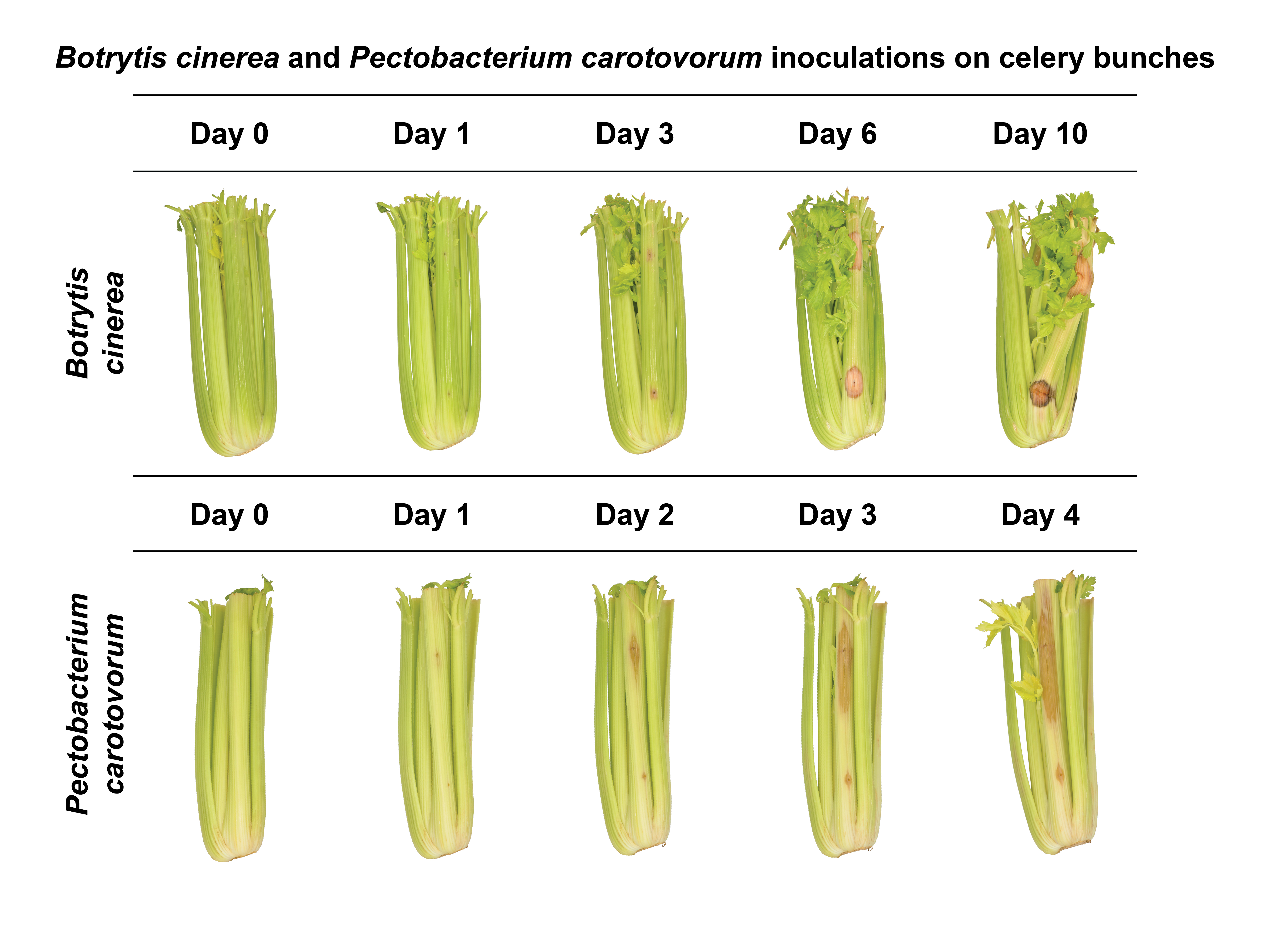
Fig. 6. Fresh-cut celery stored at 5ׄ°C (41°F) showing three pieces with notable pithiness as well as many pieces with whitening due to surface drying. Photo credit: Marita Cantwell
Crushing or cracking. Common, leading to rapid browning and decay. Harvesting, packing, and handling should be done with great care to prevent damage to the highly sensitive turgid petioles. Product harvested early in the morning, when pulp temperatures are lower, is more susceptible to cracking and breakage.
Pathological Disorders
Diseases are a significant source of postharvest loss, particularly when combined with rough handling and inadequate temperature control. The major bacterial and fungal pathogens that cause postharvest losses during transit, storage, and at the consumer level are Bacterial Soft-Rot (primarily Erwinia and Pseudomonas, Fig. 7), Gray Mold (Botrytis cinerea), and Watery Rot (Sclerotinia spp., Fig. 7). Botrytis and Sclerotinia can develop over a period of a few weeks, even at 2°C (35.6°F). The fungus Fusarium oxysporum causes stunting of plant growth and a dry rot in the roots (Fig. 8), but storage life is not affected if the butt is free of the fungus.

Fig. 7. Bacterial (upper) and fungal (lower) rots on stored celery. Photo credit: Adel Kader.

Fig. 8. Fusarium root rot extending into the celery butt. Photo credit: Marita Cantwell
References
Anastasiadi, M., N. Falagan, S. Rossi, and L.A. Terry. 2021. A comprehensive study of factors affecting postharvest disorder development in celery. Postharvest Biology and Technology 172, 111384. https://doi.org/10.1016/j.postharvbio.2020.111384.
Gómez, P.A. and F. Artés. 2004. Controlled atmospheres enhance postharvest green celery quality. Postharvest Biology Technology 34: 203-209. https://doi.org/10.1016/j.postharvbio.2004.04.007.
Luo, Y., T. Suslow and M. Cantwell. 2016. Celery. Pp. 277-279. In: Gross, K.C., C. Y. Wang, and M. Saltveit, eds. The Commercial Storage of Fruits, Vegetables, and Florist and Nursery Stocks. Agriculture Handbook 66, USDA. https://www.ars.usda.gov/is/np/CommercialStorage/CommercialStorage.pdf.
Raffo, A., F. Sineslo, E. Moneta, N. Nardo, M. Peparaio, and F. Paoletti. 2006. Internal quality of fresh and cold stored celery petioles described by sensory profile, chemical and instrumental measurements. European Food Research and Technology 222: 590-599. https://doi.org/10.1007/s00217-005-0098-7.
Saltveit, M.E., and M.E. Mangrich. 1996. Using density measurement to study the effect of excision, storage, abscisic acid, and ethylene on pithiness in celery petioles. Journal of the American Society for Horticultural Science 121:137-141. https://doi.org/10.21273/JASHS.121.1.137.
Thompson, A. K., R.K.Prange, R.D. Bancroft, and T. Puttongsiri, 2018. Recommended CA conditions. Ch 12, pp. 207-208. In: Controlled Atmosphere Storage of Fruit and Vegetables, 3rd ed., A.K. Thompson, R.K. Prange, R.D. Bancroft, T. Puttongsiri, eds. CABI, Wallingford, UK.
USDA. 1959. United States standards for grades of celery. https://www.ams.usda.gov/sites/default/files/media/Celery_Standard%5B1%5D.pdf